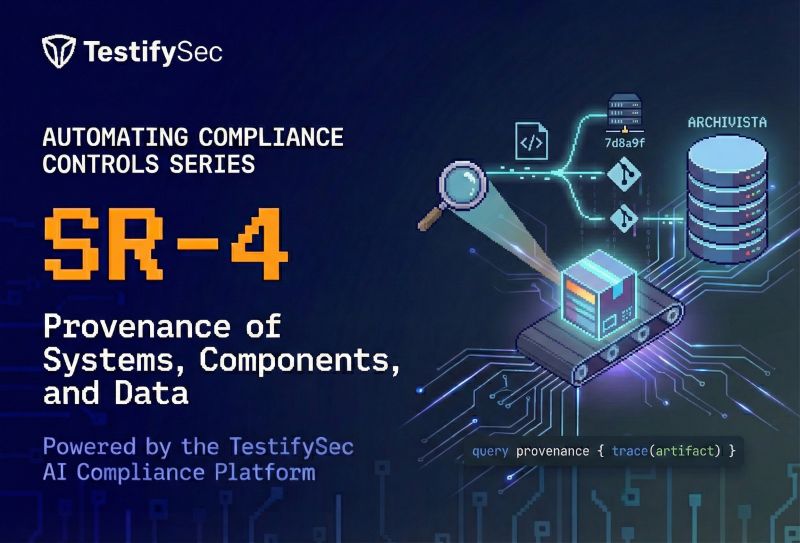
Modern Software Is Assembled, Not Written: Proving Component Provenance
Modern software is assembled, not written. Do you know exactly where the parts came from?
Today's applications are complex ecosystems of components, dependencies, and third-party libraries. A single microservice might include hundreds of packages, each with their own dependencies. Tracking provenance manually? Impossible at DevOps speed.
The Assembly Line Reality
Modern Development Components
Software development has evolved from writing code line-by-line to orchestrating components:
- npm packages with transitive dependencies 20+ levels deep
- Container base images that change daily
- Third-party APIs and services integrated at runtime
- AI-generated code from tools like GitHub Copilot
The Hidden Complexity
Each component introduces potential vulnerabilities, licensing issues, and compliance gaps. Without provenance tracking, you're deploying software you don't fully understand.
A single dependency update can cascade through dozens of components, creating unexpected security exposures.
The Trust Problem
Manual Processes Fail at Scale
Traditional approaches rely on manual processes:
- Developers self-report what they used
- Security teams scan after the fact
- Compliance teams audit with spreadsheets
- Operations teams hope nothing breaks
Hope Isn't a Strategy
But hope isn't a strategy. Cryptographic proof is.
When a vulnerability is discovered in a widely-used component, can you instantly identify which of your services are affected? Manual tracking makes this nearly impossible.
TestifySec's Solution: Digital Birth Certificates
1. Birth Certificate (Build Time)
Every artifact gets a cryptographically signed “birth certificate”:
- SLSA v1.0 provenance documents that capture build metadata
- Sigstore signatures providing tamper-evident seals
- Content-addressable identifiers that are unique and immutable
This creates an immutable record of what was built, when, where, and by whom.
2. Ancestry Database (Traceability)
Signed attestations stream into a graph database, enabling:
- Complete lifecycle traceability from source to deployment
- Instant queries by artifact hash to reveal full history
- Supply chain visualization showing component relationships
Want to know if your production service contains a vulnerable library? Query by CVE and get instant answers across your entire software estate.
NIST 800-53 Control SR-4 Compliance
This approach directly satisfies NIST 800-53 Control SR-4 (Provenance) requirements:
- ✓Document valid provenance for all software components
- ✓Track supply chain elements throughout their lifecycle
- ✓Verify components haven't been tampered with using cryptographic hashes
From Trust to Proof
Instead of asking “Do you trust this component?”, we can cryptographically prove:
- Where it came from (source repository, build environment)
- When it was built (timestamp, build ID)
- What went into it (dependencies, base images, build tools)
- Who approved it (code review attestations, signatures)
The Future of Software Supply Chains
Manual provenance tracking is a relic of the past. Modern software demands modern solutions: cryptographic proof of component authenticity and origin.
Because when you're assembling software at cloud scale, you need more than trust—you need certainty.