
System architecture
TestifySec connects three jobs: record the work, evaluate the evidence, and act on the decision. CI/lock, Pushgate, and the platform participate at different points. You can start with the part your workflow needs.
Read the trust model alongside this page. Architecture explains where a record travels; the trust model explains what a reviewer can conclude from it.
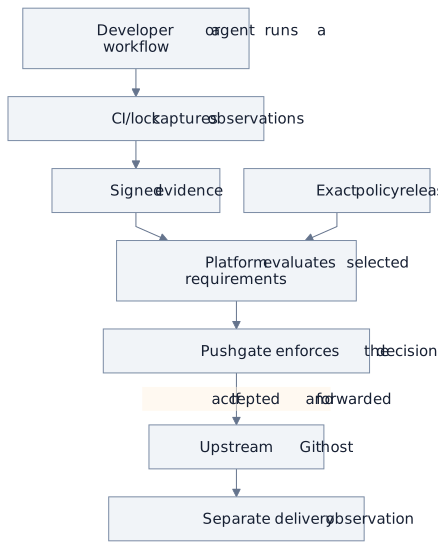
Scroll horizontally to explore the diagram, or open the full-size SVG.
Diagram source (Mermaid)
flowchart TB
  W[Developer or agent runs a workflow] --> C[CI/lock captures observations]
  C --> E[Signed evidence]
  E --> P[Platform evaluates selected requirements]
  R[Exact policy release] --> P
  P --> G[Pushgate enforces the decision]
  G -->|If accepted and forwarded| U[Upstream Git host]
  U --> D[Separate delivery observation]
One system, different responsibilities
| Component | Responsibility | What it does not establish by itself |
|---|---|---|
| CI/lock | Collect configured workflow observations and produce signed execution evidence. | That every supplied report is truthful, the collector is uncompromised, or the code is safe. |
| TestifySec Platform | Manage repository gates, policies, identities, evidence, and mappings between technical results and controls. Evaluate evidence against the selected requirements. | That an unsigned description is authoritative or a passing technical check satisfies a whole compliance program. |
| Pushgate | Enforce the configured repository decision at the Git push boundary. | That direct paths around the gate are protected or that an accepted push was delivered upstream. |
| Software appliance | Run the platform within an agreed customer-operated environment. | A different trust model with no operator responsibilities or external dependencies in every configuration. |
Follow a repository change
- Record the work. Run the required build, test, or scan under the intended collection boundary. CI/lock captures the configured observations. The record needs the subject and identity information required by the policy.
- Make the evidence available. Store the signed record where the verifier can retrieve it. Upload authority and signing authority are separate; being allowed to upload a record does not make its producer trusted.
- Select the requirements. The repository's configured assignment identifies the policy to evaluate. A display name or a mutable
latestlabel is not the policy's immutable identity. - Evaluate the evidence. The platform checks the selected requirements and records the decision with its required repository, commit, policy, and evidence bindings.
- Enforce at the gate. Pushgate uses that bounded decision for the push. Protect alternate routes at the Git host as part of the repository configuration.
- Inspect the result. Distinguish a policy decision, gate acceptance, and downstream delivery. A delivery record must be interpreted according to what its deployed receipt version actually binds.
A signed policy artifact, a published release, and a repository assignment are separate objects. Signing a policy does not activate it for a repository. An assignment approval does not make the approving account the policy author.
Continue with Pushgate setup and its security coverage.
Follow a technical-control assessment
A recovery rehearsal, remediation verification, or configuration check can use the same evidence foundations without involving a Git push.
- Define the technical requirement and the test that observes it.
- Run the test with CI/lock under the intended collection boundary.
- Inspect the signed result and its subject, producer, and scope.
- Map the result to the technical control it supports in the platform.
- Review the assessment's coverage, remaining gaps, and freshness.
The mapping expresses a relationship between evidence and a control. It does not expand the test's scope. A successful recovery rehearsal for one service does not prove recovery works for every system.
Start with one part, reuse the same concepts
| Starting point | Immediate task | What can follow |
|---|---|---|
| CI/lock | Record and verify one workflow. | Reuse accepted evidence in a repository gate or a technical-control assessment. |
| Pushgate | Protect one repository's push path. | Manage additional connected gates and their requirements through the platform. |
| Technical controls | Review the result of a real operational check. | Build repeatable assessments from scoped tests and configured mappings. |
| Platform deployment | Agree the operating and trust boundary. | Configure identity, evidence storage, policies, repository connections, and support for that environment. |
Deployment changes who operates the boundary
Hosted and appliance deployments need explicit answers about the trusted roots, signing services, evidence storage, administrator authority, updates, backups, and recovery. A customer-operated deployment moves operating responsibility; it does not remove it.
Some workflows can verify portable evidence offline. That is a specific verification capability, not a promise that every connected repository, identity provider, or deployment workflow operates without a network.
Choose a workflow, then review what the system proves and what it assumes.